How might self-efficacy and self-regulation contribute to the intervention plans you use in your case study?
Elementary Education Case Study:
You engage your third grade students in cooperative learning activities at least twice a day, changing heterogeneous group members once every four weeks. You have agreed upon routine procedures that your classroom community uses within their small groups, including the roles and responsibilities of group members. Lately, you have noticed that one small group always seems to have difficulty grasping material and completing their project in an acceptable manner. You observe this group carefully and find that Lisa seems to be the catalyst for their problems. She gets angry with others if she does not get the job she wants and refuses to do her part in contributing to the group's learning. She constantly interrupts others in her group. She does not pay attention when her group prepares for class presentations.
According to Ormrod in Educational Psychology: Developing Learners, Social Cognitive Theory is "a perspective that can help us understand what and how people learn by observing others and how, in the process, they begin to take control of their own behavior" (p. 323). Social Cognitive Theory assumes that individuals with high self-efficacy and the ability to self-regulate will be able to control their behavior and therefore will be able to behave in an appropriate, productive manner. Self-efficacy refers to individuals' expectations about their ability to successfully complete tasks or attain certain goals. Self-regulation involves the goals people set for themselves, the way in which people monitor and evaluate their own cognitive processes and behaviors, and the consequences people impose on themselves for successes and failures.
In this elementary education case study, I worry that Lisa is acting out because she is attempting to avoid the academic task at hand. As a part of Lisa's behavioral intervention plan, I would first identify the reason behind the misbehavior. If I determine that the misbehavior is in fact an avoidance of the academic task, I will take measures to boost Lisa's self-efficacy in regards to group work. In assigning Lisa a role within her group, I will make sure that Lisa has the skill set required to complete the role task. I will then ensure that Lisa understands what measures she must take to fulfill her role within the group. Once she fully understands her responsibilities, I will encourage her and help her realize that she is capable of successfully carrying out those responsibilities. In implementing these strategies, I hope to that Lisa's self-efficacy for group projects will increase. If Lisa believes that she can successfully fulfill her role and contribute to the group, I predict that her "acting out" behaviors will dramatically decrease.
In this elementary education case study, Lisa is prone to angry outbursts during cooperative group work activities. For this reason, as a part of Lisa's behavior intervention plan, I will work with Lisa on emotional self-regulation. I will help Lisa deal with her frustrations in a socially appropriate manner. Because I want Lisa to be able to regulate her emotions and her behavior at school and at home, I will hold a conference with Lisa and her parents to develop a plan for addressing this issue. During the conference, we will discuss the fact that Lisa is in control of behavior. I want Lisa to realize, that even when she becomes frustrated or upset, she can still behavior in an appropriate, respectful manner. In this ARTICLE, Ida Florez emphasizes three strategies that can help children learn to self-regulate. These strategies include: modeling, using hints and cues, and scaffolding. After making Lisa aware that she can regulate her emotions and behaviors, I will help Lisa develop her self-regulation abilities by modeling self-regulation, providing her with cues when I feel she is "outburst-prone," and scaffolding. To model self-regulation, I will demonstrate appropriate behavior even when I feel upset or overwhelmed. To further help Lisa learn to self-regulate, I will provide Lisa with simple directions, gestures, and touch to guide her behavior, emotions, and attention. Because I want Lisa to be able to regulate her behavior and emotions on her own, I will gradually withdrawal my supports and guidance as Lisa improves her self-regulation skills (scaffolding). Hopefully, these measures will prove successful and will result in a happy, effective cooperative learning group.
Saturday, March 16, 2013
Tuesday, March 12, 2013
PLE Post 8: Behaviorism and Constructivism
Consider your CSEL intervention case study. Are there tools from a behaviorist view for either encouraging productive behaviors or discouraging undesirable behaviors that you could apply to the case? What are they?
Now, compare the interventions that you have identified above with what you think might work from a cognitive or constructivist viewpoint (you may need to Google for ideas but it's okay to just speculate based on your prior knowledge). How do they compare to behaviorist tools? What are the benefits of each theory, and what are the deficits? Which theory might play a larger role in how you determine classroom management?
The Elementary Education Case Study:
You engage your third grade students in cooperative learning activities at least twice a day, changing heterogeneous group members once every four weeks. You have agreed upon routine procedures that your classroom community uses within their small groups, including the roles and responsibilities of group members. Lately you have noticed that one small group always seems to have difficulty grasping material and completing their project in an acceptable manner. You observe this group carefully and find that Lisa seems to be the catalyst for their problems. She gets angry with others if she does not get the job she wants and refuses to do her part in contributing to the group's learning. She constantly interrupts others in her group. She does not pay attention when her group prepares for class presentations.
To answer the first part of the prompt, yes. The case study above describes a behavior problem. If I were to take a behavioral approach to this behavior problem, I might implement Applied Behavior Analysis. Applied Behavior Analysis is "a systematic application of behaviorist principles in education settings (Lecture)." ABA operates under two assumptions: "behavior problems result from past and present environmental circumstances AND modifying a learner's present environment will promote more productive responses (Lecture)." To utilize ABA in the Elementary Education Case Study, I would carefully observe and operationally define Lisa's problematic behaviors. I would also carefully observe and note the instances in which Lisa exhibits appropriate behavior. I would then determine one or more effective reinforcers. These reinforcers might include verbal praise, discrete praise (passing Lisa a note), candy, stickers to go in an incentive chart, free time, computer time, eating lunch in the classroom, being line leader, etc. In ABA, it is crucial to identify effective reinforcers. What may be reinforcing to one student may not be reinforcing to another. Implementing reinforcement strategies will increase Lisa's appropriate behaviors. To address Lisa's inappropriate behavior, I might resort to punishment or extinction strategies. When Lisa interrupts her group members, I might "punish" her by taking away 5 minutes of her recess time (negative punishment) or by having her complete an extra assignment (positive punishment). In using ABA as Lisa's behavior intervention plan, I would also explicitly communicate desired behaviors to Lisa. I would be sure to measure the frequency of undesired and desired behaviors before and after treatment to determine the effectiveness of my intervention strategies. If my records indicate little or no progress, I would reevaluate and alter my reinforement and punishment methods. If the behavior intervention plan proved successful, I would gradually "phase out treatment after desired behaviors are occurring regularly." To learn more about ABA, visit Education.com. This webpage breaks down ABA by focusing on the meaning of "Applied," "Behavior," and "Analysis."
In constructivist learning theory, learners construct new knowledge by building on their previous knowledge and understanding. In addressing Lisa's problematic behavior through a constructivist approach, I might try to better understand where Lisa is coming from. How did Lisa learn to exhibit this problematic behaviors? Experiences at home? The need for attention? The realization that disruptive behaviors sometimes allow her to escape classroom tasks? In creating an intervention plan based on constructivism, I would attempt to help Lisa reconstruct some of her knowledge and assumptions. I would want her to know that she can get what she wants, to a degree, without interrupting, displaying anger, pitching fits, etc. Like my behaviorist approach, this constructivist approach involves replacing inappropriate behaviors with appropriate behaviors to achieve the desired outcome. The ABA strategy provides detailed methods to acheive this goal. The constructivist strategy is much more ambiguous in nature. I really like that the constructivist approach respects the fact that Lisa is a complex individual who requires a complex, thoughtful intervention plan. However, I think that ABA offers a more practical solution to Lisa's situation.
In dealing with classroom management issues, I feel that the behaviorist approach will oftentimes prove most effective. Problem behaviors are easily observable and identifiable. I can quickly deliver reinforcement or punishment based on the type of behavior exhibited by the student.
Now, compare the interventions that you have identified above with what you think might work from a cognitive or constructivist viewpoint (you may need to Google for ideas but it's okay to just speculate based on your prior knowledge). How do they compare to behaviorist tools? What are the benefits of each theory, and what are the deficits? Which theory might play a larger role in how you determine classroom management?
The Elementary Education Case Study:
You engage your third grade students in cooperative learning activities at least twice a day, changing heterogeneous group members once every four weeks. You have agreed upon routine procedures that your classroom community uses within their small groups, including the roles and responsibilities of group members. Lately you have noticed that one small group always seems to have difficulty grasping material and completing their project in an acceptable manner. You observe this group carefully and find that Lisa seems to be the catalyst for their problems. She gets angry with others if she does not get the job she wants and refuses to do her part in contributing to the group's learning. She constantly interrupts others in her group. She does not pay attention when her group prepares for class presentations.
To answer the first part of the prompt, yes. The case study above describes a behavior problem. If I were to take a behavioral approach to this behavior problem, I might implement Applied Behavior Analysis. Applied Behavior Analysis is "a systematic application of behaviorist principles in education settings (Lecture)." ABA operates under two assumptions: "behavior problems result from past and present environmental circumstances AND modifying a learner's present environment will promote more productive responses (Lecture)." To utilize ABA in the Elementary Education Case Study, I would carefully observe and operationally define Lisa's problematic behaviors. I would also carefully observe and note the instances in which Lisa exhibits appropriate behavior. I would then determine one or more effective reinforcers. These reinforcers might include verbal praise, discrete praise (passing Lisa a note), candy, stickers to go in an incentive chart, free time, computer time, eating lunch in the classroom, being line leader, etc. In ABA, it is crucial to identify effective reinforcers. What may be reinforcing to one student may not be reinforcing to another. Implementing reinforcement strategies will increase Lisa's appropriate behaviors. To address Lisa's inappropriate behavior, I might resort to punishment or extinction strategies. When Lisa interrupts her group members, I might "punish" her by taking away 5 minutes of her recess time (negative punishment) or by having her complete an extra assignment (positive punishment). In using ABA as Lisa's behavior intervention plan, I would also explicitly communicate desired behaviors to Lisa. I would be sure to measure the frequency of undesired and desired behaviors before and after treatment to determine the effectiveness of my intervention strategies. If my records indicate little or no progress, I would reevaluate and alter my reinforement and punishment methods. If the behavior intervention plan proved successful, I would gradually "phase out treatment after desired behaviors are occurring regularly." To learn more about ABA, visit Education.com. This webpage breaks down ABA by focusing on the meaning of "Applied," "Behavior," and "Analysis."
In constructivist learning theory, learners construct new knowledge by building on their previous knowledge and understanding. In addressing Lisa's problematic behavior through a constructivist approach, I might try to better understand where Lisa is coming from. How did Lisa learn to exhibit this problematic behaviors? Experiences at home? The need for attention? The realization that disruptive behaviors sometimes allow her to escape classroom tasks? In creating an intervention plan based on constructivism, I would attempt to help Lisa reconstruct some of her knowledge and assumptions. I would want her to know that she can get what she wants, to a degree, without interrupting, displaying anger, pitching fits, etc. Like my behaviorist approach, this constructivist approach involves replacing inappropriate behaviors with appropriate behaviors to achieve the desired outcome. The ABA strategy provides detailed methods to acheive this goal. The constructivist strategy is much more ambiguous in nature. I really like that the constructivist approach respects the fact that Lisa is a complex individual who requires a complex, thoughtful intervention plan. However, I think that ABA offers a more practical solution to Lisa's situation.
In dealing with classroom management issues, I feel that the behaviorist approach will oftentimes prove most effective. Problem behaviors are easily observable and identifiable. I can quickly deliver reinforcement or punishment based on the type of behavior exhibited by the student.
Monday, March 4, 2013
PLE Post 7: Metacognitive Skills
Consider a lesson plan you might use. Which metacognitive skills/abilities are involved as students gain facility/knowledge in this domain?
According to SpringerReference.com, "Metacognitive skills are strategies applied consciously or automatically during learning, cognitive activity, and communication to manipulate cognitive processes before, during, or after a cognitive activity. Examples are executive function processes such as verbal mediation, self-regulation, planning, judgment, and self-monitoring."
For this post, I will focus on a Read-Aloud lesson that focuses on developing students' comprehension skills by helping them develop and practice metacognitive strategies. I actually observed one of my friends conduct this lesson in her first-grade classroom this past fall. This lesson activity reflects the first grade reading standard, CCSS.ELA-Literacy.RL.1.3, "Describe characters, settings, and major events in a story, using key details."
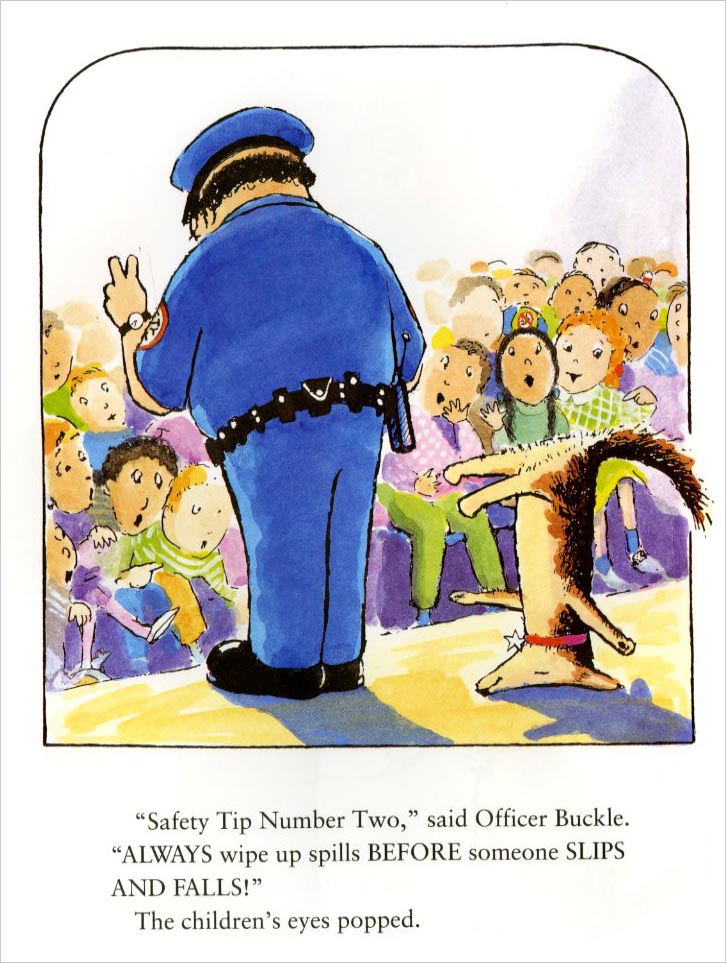
For this Read-Aloud, the teacher selected the children's book, Officer Buckle and Gloria, by Peggy Rathmann.
In conducting the Read-Aloud, the teacher facilitated the utilization and development of the metacognitive skills necessary for comprehension in her students. I will now list some of the techniques she used throughout the Read-Aloud to accomplish this facilitation.
I was amazed at the students' abilities to apply metacognitive comprehension skills before, during, and after reading/listening to Officer Buckle and Gloria . After taking Reading Education 430, I realize the importance of explicitly teaching comprehension strategies to even the youngest of readers. "Kindergartners Can Do It, Too! Comprehension Strategies for Early Readers," by Anne E. Gregory and Mary Ann Cahill, outlines some of the strategies I mentioned in this post. This article is a wonderful resource for those intending to teach the primary grades!
According to SpringerReference.com, "Metacognitive skills are strategies applied consciously or automatically during learning, cognitive activity, and communication to manipulate cognitive processes before, during, or after a cognitive activity. Examples are executive function processes such as verbal mediation, self-regulation, planning, judgment, and self-monitoring."
For this post, I will focus on a Read-Aloud lesson that focuses on developing students' comprehension skills by helping them develop and practice metacognitive strategies. I actually observed one of my friends conduct this lesson in her first-grade classroom this past fall. This lesson activity reflects the first grade reading standard, CCSS.ELA-Literacy.RL.1.3, "Describe characters, settings, and major events in a story, using key details."
For this Read-Aloud, the teacher selected the children's book, Officer Buckle and Gloria, by Peggy Rathmann.
In conducting the Read-Aloud, the teacher facilitated the utilization and development of the metacognitive skills necessary for comprehension in her students. I will now list some of the techniques she used throughout the Read-Aloud to accomplish this facilitation.
- Introduction: The teacher introduced the book by relating the book to the theme of the week, "community." She asked her students to think of some people they know who work for and within the community. Students responded saying, "police officers," "teachers," "mailmen," "librarians," "firefighters," "the mayor," etc. The teacher also asked students to predict what they thought the book would be about. She communicated to her students that the connections they made to the book and their predictions would help them to better comprehend the content of the book. Making connections and predictions are metacognitive skills that enhance comprehension.
- Making Connections and Hand-Signaling: Before I observed this lesson, the teacher had explicitly taught students to make connections while reading. Throughout the Read-Aloud I observed, students continually made connections between the text and the illustrations and their real-life experiences. Students indicated that they had made a connection, by forming the letter, "C," with their hands. When the teacher realized, from the hand-signals, that several students had connections to share, she called on them individually and had them explain their connection. The students were all so eager to form connections and share their connections with their classmates. The ability to make connections to a text while reading is a crucial metacognitive skill.
- Visualizing and Hand-Signaling: Prior to my observation, the teacher had explicitly taught her students to visualize or to make "mind-movies" while reading or listening to a text. When students had a "mind-movie" to share, they held up one of their hands in the shape of a "V" (visualization). Just as in the case of "connections," students could not wait to share their "mind movies." The ability to visualize while reading a text is a metacognitive skill that greatly enhances comprehension. It was so much fun to hear the creative, "out-there" mind-movies that some of the children came up with.
- Questioning to Monitor: Throughout the Read-Aloud, the teacher posed questions to her students to ensure that her students were listening to and understanding the story. She continually explained to her students why she was asking these questions, "Asking questions helps us to make sure we understand the text. We don't want to read the whole book and then realize we didn't comprehend anything! We must ask questions throughout the reading to check or to monitor our comprehension." In explicitly teaching questioning techniques to her students, this teacher is helping her students develop yet another important metacognitive skill relating to reading comprehension.
- Reflection: After finishing the story, the teacher initiated a class discussion about the characters, the setting, and the main events. This reflection also included how the students felt about the story overall. Did they enjoy the story? How did they feel about the characters? What would life be like if they were one of the characters? In reflecting on the major events, the setting, and the characters in the story, students are making further connections to the story. These deeper connections strengthen comprehension. Therefore, reflection and discussion allow students to further develop their reading comprehension metacognitive skills/strategies.
I was amazed at the students' abilities to apply metacognitive comprehension skills before, during, and after reading/listening to Officer Buckle and Gloria . After taking Reading Education 430, I realize the importance of explicitly teaching comprehension strategies to even the youngest of readers. "Kindergartners Can Do It, Too! Comprehension Strategies for Early Readers," by Anne E. Gregory and Mary Ann Cahill, outlines some of the strategies I mentioned in this post. This article is a wonderful resource for those intending to teach the primary grades!
Sunday, February 24, 2013
PLE Post 6: Constructivism
Make a list of the sequence skills necessary for ultimate mastery of the content of your lesson through a constructivist approach. Which of these learning activities/skills lend themselves to student's individual or group construction? How might you structure learning activities that lead students to discover these skills/these principles?
For this post, I chose to focus on a first grade math lesson (Previously discussed in PLE Post 4). This lesson focuses on the greater than/less than concept. For students to reach grade level mastery of the content, students must be able to "compare two two-digit numbers based on meanings of the tens and ones digits, recording the results of comparisons with the symbols >, =, and <" (CCSS).
List of skills needed to achieve mastery...
For this post, I chose to focus on a first grade math lesson (Previously discussed in PLE Post 4). This lesson focuses on the greater than/less than concept. For students to reach grade level mastery of the content, students must be able to "compare two two-digit numbers based on meanings of the tens and ones digits, recording the results of comparisons with the symbols >, =, and <" (CCSS).
List of skills needed to achieve mastery...
- Activate students prior knowledge of greater than/less than concepts
- Present students with two uneven piles of M&Ms and have them explain which pile is greater and why? Because this involves class discussion and exploration, this task involves social construction.
- Ask students to think of a time they had to determine which amount was greater than/less than (money, food, beads, toys, etc). Have them share their thoughts and experiences with their partners/classmates. This particular task involves both individual and social construction.
- Address misconceptions/confirmation bias
- Students may determine the greater number using an incorrect method (looking at the ones place rather than the tens place, 28 > 32).
- Conduct activities that help students realize why and how their misconceptions are incorrect
- Use math manipulatives to reveal to students why they need to first compare the tens place of the two numbers, then move on to compare the ones place if the two numbers share the same tens place digit. Students' hands-on interaction with manipulatives can help them realize that comparing the ones place of two numbers is insufficient to determine which number is greater and which number is lesser.
- Readdress misconceptions. Discuss why misconceptions about greater than/less than concept were wrong. Also, discuss the reconstruction of ideas about greater than/less than concept.
- Classroom dialogue (social construction). During this classroom dialogue, students share what they thought they knew about the greater than/less than concept and what they've learned.
- Students write in reflective journals (individual reconstruction). In this journal entry, students reflect on what they've learned about the greater than/less than concept.
- Engage in multiple authentic activities on greater than/less than concept
- I visited Education.com and found some valuable information on developing and implementing authentic activities in the classroom. In visiting this webpage, I learned that authentic activities are "relevant, accessible, feasible, sustainable, and aligned with learning goals."
- Present students with problems possessing real-life relevance (Individual or social construction).
- For example..."If you have 42 cents and your brother has 28 cents, which of you has more money?"
- Continual engagement in authentic activities, reflection, and class dialogue.
Tuesday, February 19, 2013
PLE Post 5: Memory and Instruction
How might your knowledge of the memory processes guide your instructional decisions?
We, our Ed Psych class, have spent the last few class periods discussing and learning about long-term memory storage and retrieval. I now understand the effect rehearsal, regular practice, meaningful instruction, making connections, relevance, learning across contexts, emotional connections, retrieval cues, distinctiveness, and allotting adequate wait time have on one's ability to remember. After investigating and discovering how students remember, I now know how to teach in such a way that will facilitate this "remembering." When planning, I will always allow time for activating prior knowledge, making connections, explaining relevance, and review. When introducing novel concepts, I always want to provide distinct examples for clarification, application, and deeper understanding. I will also consciously focus on allowing adequate wait time. Last semester, my Reading Education 430 instructor shared with our class that she provides 8 seconds of wait time before answering the question herself or altering her question. I intend to model her method. When appropriate, I also want to enable students to make emotional connections, teach retrieval cues such as HOMES (Huron, Ontario, Michigan, Erie, and Superior), and practice cross-curricular instruction.
Earlier today, Allie Carey and I presented on long-term retrieval to our Ed Psych class. We conducted a "smells activity" to demonstrate the effect that odor has on one's ability to recall memories formed long ago. We found an article on the Association for Psychological Science website, that discussed the strong influence odors have on memory, especially in children. We distributed different scents (objects with distinctive odors such as crayons, cedar chips, pencil shavings in ziploc baggies) to students and asked them to share any memories conjured up by the smell with their nearby classmates. While I understand that few opportunities to incorporate "smells" into my lessons will arise, I want to try to involve "smells" in my lessons whenever appropriate. For example, if students are learning about the plant life cycle, I might bring in flowers for students to sniff. Perhaps then my students might make an association between their knowledge of the plant life cycle and a floral scent. Hopefully, this association will strengthen students' understanding and knowledge of the plant life cycle and will allow them to store this knowledge in their long-term memory.
We, our Ed Psych class, have spent the last few class periods discussing and learning about long-term memory storage and retrieval. I now understand the effect rehearsal, regular practice, meaningful instruction, making connections, relevance, learning across contexts, emotional connections, retrieval cues, distinctiveness, and allotting adequate wait time have on one's ability to remember. After investigating and discovering how students remember, I now know how to teach in such a way that will facilitate this "remembering." When planning, I will always allow time for activating prior knowledge, making connections, explaining relevance, and review. When introducing novel concepts, I always want to provide distinct examples for clarification, application, and deeper understanding. I will also consciously focus on allowing adequate wait time. Last semester, my Reading Education 430 instructor shared with our class that she provides 8 seconds of wait time before answering the question herself or altering her question. I intend to model her method. When appropriate, I also want to enable students to make emotional connections, teach retrieval cues such as HOMES (Huron, Ontario, Michigan, Erie, and Superior), and practice cross-curricular instruction.
Earlier today, Allie Carey and I presented on long-term retrieval to our Ed Psych class. We conducted a "smells activity" to demonstrate the effect that odor has on one's ability to recall memories formed long ago. We found an article on the Association for Psychological Science website, that discussed the strong influence odors have on memory, especially in children. We distributed different scents (objects with distinctive odors such as crayons, cedar chips, pencil shavings in ziploc baggies) to students and asked them to share any memories conjured up by the smell with their nearby classmates. While I understand that few opportunities to incorporate "smells" into my lessons will arise, I want to try to involve "smells" in my lessons whenever appropriate. For example, if students are learning about the plant life cycle, I might bring in flowers for students to sniff. Perhaps then my students might make an association between their knowledge of the plant life cycle and a floral scent. Hopefully, this association will strengthen students' understanding and knowledge of the plant life cycle and will allow them to store this knowledge in their long-term memory.
PLE Post 4: Cognitive Learning
What are the essential skills and/or learning outcomes you want your students to know and be able to do that relate to cognitive learning?
Even though I intend to teach early elementary students, I want my students to understand that in order to learn, one must think. I understand that, for young students, "cognition" and "metacognition" may be difficult concepts to grasp. However, I really want to help my students understand that they must stimulate their minds in order to learn.
To help my students better understand these intimidating terms, I might engage in a whole-class discussion on "cognition" and "metacognition" with my students. I would guide the discussion and acknowledge/expound on student input. Students are capable of understanding that "cognition" refers to thinking processes. Additionally, in the case of metacognition, I want my students to determine how they, as individuals, learn best. I might have my students complete a learning style inventory to help them identify their preferred learning style. Although I would have to adapt this inventory for younger elementary students, I really like this learning styles survey I found on Edutopia Survey. I plan to carefully consider the different types of learners in my future classroom and differentiate my instruction based on their needs.
On Education.com, I found a great article on developing metacognitive behaviors in students. The author proposes 6 strategies for "developing metacognitive behaviors:"
Even though I intend to teach early elementary students, I want my students to understand that in order to learn, one must think. I understand that, for young students, "cognition" and "metacognition" may be difficult concepts to grasp. However, I really want to help my students understand that they must stimulate their minds in order to learn.
To help my students better understand these intimidating terms, I might engage in a whole-class discussion on "cognition" and "metacognition" with my students. I would guide the discussion and acknowledge/expound on student input. Students are capable of understanding that "cognition" refers to thinking processes. Additionally, in the case of metacognition, I want my students to determine how they, as individuals, learn best. I might have my students complete a learning style inventory to help them identify their preferred learning style. Although I would have to adapt this inventory for younger elementary students, I really like this learning styles survey I found on Edutopia Survey. I plan to carefully consider the different types of learners in my future classroom and differentiate my instruction based on their needs.
On Education.com, I found a great article on developing metacognitive behaviors in students. The author proposes 6 strategies for "developing metacognitive behaviors:"
- Identifying "what you know" and "what you don't know."
- Talking about thinking. (Think-Aloud)
- Keeping a thinking journal.
- Planning and self-regulation.
- Debriefing the thinking process.
- Self-evaluation.
Wednesday, February 6, 2013
PLE Post 4: Chapter 14 Assessment
Think of a lesson plan from your licensure area. Know that assessment is an integral part of teaching, explain at least four formal and informal assessments that you will use in your lesson plan to provide you with feedback and involve the students in assessing their own learning.
This past Monday, for the math portion of my Elementary Education 422 class, we all (students) completed a lesson planning activity. Our class broke up into small groups, and each group member conducted his or her lesson for the group, as if group members were elementary students. I absolutely loved one of my group member's lessons. This math lesson involves the greater than/less than concept and symbols and is intended for first graders. I found an example of this particular lesson on a teaching blog, Pre-K and K Sharing Blog. Hopefully, exploring that link will better convey the components of the lesson. Keep in mind that the example lesson shown here is intended for Pre-K-K. To adapt this lesson for first grade, simply use two-digit numbers.
Standard addressed in this activity...
CCSS.Math.Content.1.1.NBT.3 Compare two two-digit numbers based on meanings of the tens and ones digits, recording the results of comparisons with the symbols >, =, and <.
Brief outline of this lesson...
- Review greater than/less than concept and signs (<, =, >).
- Introduce the alligator jaws made out of popsicle sticks. Explain that the "alligator" is very hungry and that its mouth should always be open to larger number because he wants to "eat" as much as possible.
- Explain that the alligator mouth represents the greater than and less than signs. Explain to students that two numbers will be presented to them, and they are to place the alligator's mouth open to the larger number (because alligator is hungry and he wants the greater/larger portion).
- Have students work in pairs on the activity. Monitor the task and question students about their reasoning as you work your way around the room. Have students record their answers on a worksheet containing each question. For example the worksheet would read "9 7." Students would write in the correct sign, "9 > 7."
- At the end of the lesson, teacher should pose questions to students and have them offer up their thoughts on the activity and their reasoning behind their choices.
Now that I have provided a rough outline of this lesson, I will now include 4 informal and 4 formal forms of assessment that I could use to provide me with feedback on students' learning/understanding and to involve my students in assessing their own learning.
4 possible informal assessments I could use in relation to this lesson...
- Thumbs Up/Thumbs Down/Thumbs in the Middle: During this lesson, I could periodically ask students how they are feeling about the activity. If students are feeling confident in working with the greater than/less than alligator sign, then they should signal "thumbs up." If students are feeling okay about their ability to correctly place the greater than/less than sign, then they should signal "thumbs in the middle." If students are really confused about what they are supposed to be doing or the concept of greater than/less than, then they should signal "thumbs down." This form of assessment would provide me with immediate information on students' level of understanding on this task.
- Post Its: After conducting this lesson, I would place a sticky note (Post It) on each child's desk. I would ask students to write how they are feeling about the greater than/less than concept on the sticky notes. These sticky notes would provide me with valuable information that would help me determine future lessons/instruction.
- Explain to your neighbor/Observation: In this assessment form, I would instruct students to explain the game of "Alligator Greater than/Less Than" to the person sitting next to them. I would walk around the room and listen to check for understanding. While I would not be able to assess each child's understanding through this assessment form, I could get a general idea of how the class as a whole is comprehending the concept.
- Mini-Quiz: At the end of the lesson, I could pose 2 to 3 greater than/less than (inequality) problems on the board. I would ask each student to work the problems on a sheet of notebook paper. I would then collect these "mini-quizzes." This brief assessment would help me gauge understanding and plan appropriate future lessons/instruction.
4 possible formal assessments I could use in relation to this lesson (Note: First Graders may not be subject to formal assessments very often)...
- Unit Test: At the end of a math unit, I would likely administer a formal, summative unit test. The greater than/less than concept would be one of multiple concepts assessed through this unit tests.
- Math Journal: While this may be best categorized under "informal assessment," I chose to include "Math Journal" under "formal assessment" because it requires pre-planning. I might have each of my students keep a "Math Journal." I will provide prompts for each journal entry. For this particular journal entry, I may ask them work a greater than/less than problem. I hope that this journal will help students keep track of their own progress in math throughout the year.
- State/District Assessment: While many first graders are exempt from state/district tests, some first graders have to participate in these assessments. I would predict that knowledge of the greater than/less than concept would be assessed through these exams.
- Data collection through observation: I might keep a record of each child's understanding of different math concepts. I could record a check plus, a check, or a check minus to indicate and track each child's current understanding and progress. I could determine whether to record a check plus, a check, or a check minus based on my informal assessments.
Subscribe to:
Posts (Atom)